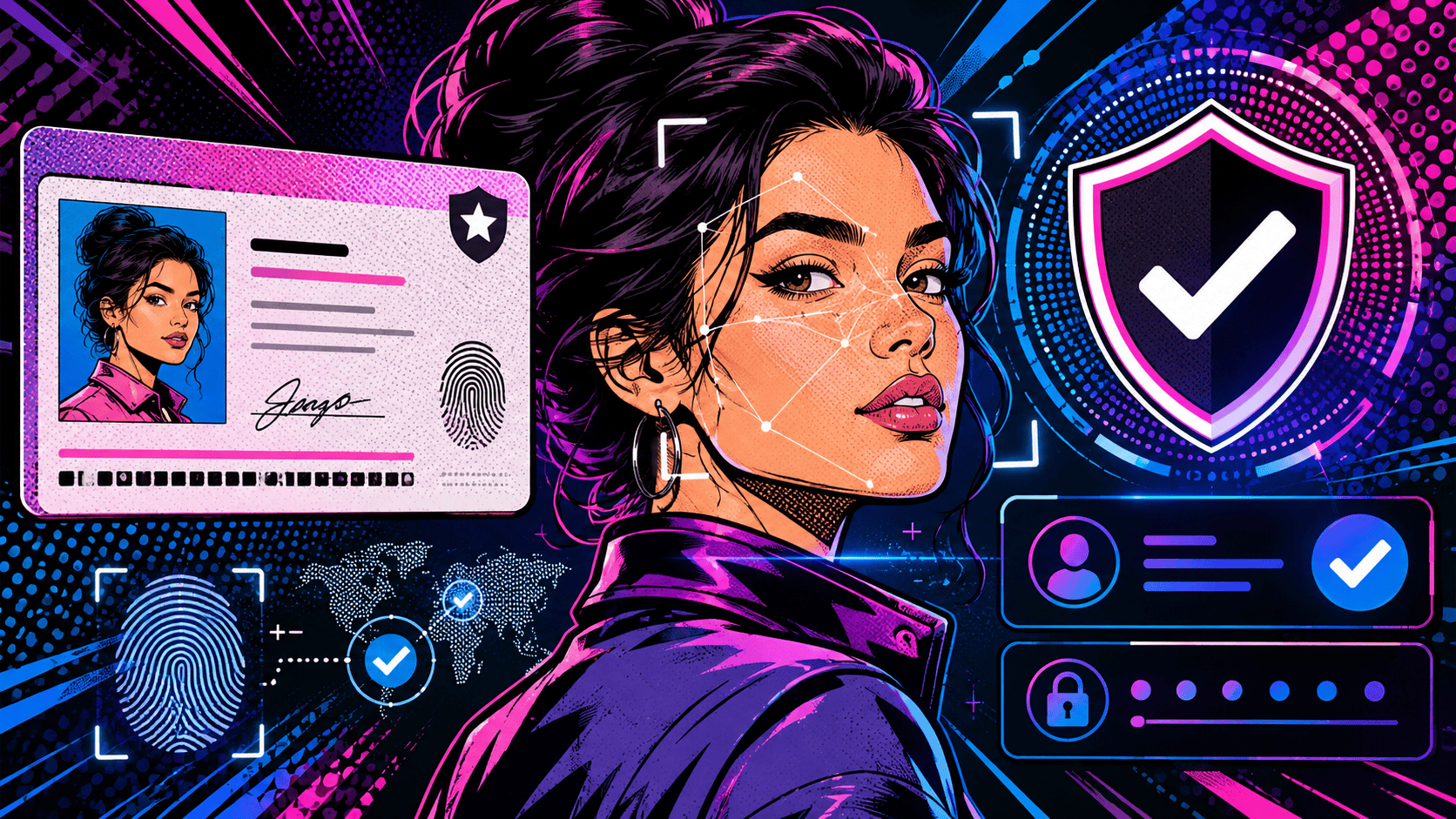
AI Girlfriend Apps & the 2026 ID-Check Wave: What It Means for Your Privacy
Right now, getting into an AI girlfriend app takes one click. You tap “yes, I’m 18,” nobody checks, and off you go. Enjoy that, because it is ending. In 2026, Georgia and Washington both passed laws making these apps verify your age for real, and a federal bill is trying to do the same nationwide. The squeeze starts in 2027.
Here is the thing nobody puts on the ad, though. The age check is not the scary part. The scary part is where your driver’s license goes after you upload it. In the past year, these “prove you’re an adult” systems have leaked piles of government IDs, and here is the fun fact: you can change your password, but you cannot exactly download a new face. So let’s talk about what the laws actually want, who has already fumbled people’s IDs, and how to keep yourself private without breaking a single rule.
How Verification Methods Compare on Privacy Risk
AI Girlfriend Age Verification in 2026: The Laws Are Real
First, let’s kill the “this is just internet drama” idea. Georgia’s SB 540 got signed on May 11, 2026 and switches on July 1, 2027. It makes AI chatbot apps check your age, add parental controls, and admit you are talking to a bot, not a person. Washington moved even faster on the calendar, signing House Bill 2225 on March 24, 2026, with the rules starting January 1, 2027.
And it is not just two states having a weird week. The Future of Privacy Forum, the people who count this stuff for a living, are tracking 98 chatbot bills across 34 states, plus three more in Congress. That is most of the country, all writing rules for your digital sweetheart at once.
Quick translation, because the wording matters: an AI companion chatbot is basically software built to feel like an ongoing relationship, chatting with you again and again like a real partner would. If it is designed to act like a girlfriend, the law is watching it. Your maps app can relax.
Then there is the big federal one, the GUARD Act. Heads up, it is still a bill, not a law yet. It cleared the Senate Judiciary Committee in spring 2026 and is now waiting on a full Senate vote. If it passes, it would require “privacy-preserving” age checks, ban anyone under 18 from AI companions, and carry fines up to $100,000 per violation. Even unfinished, it tells you exactly which way the wind is blowing, so it is worth deciding how much of your real self you’ll hand over before someone decides for you.
The Real Villain Is the Database, Not the Check
Here is the twist the lawmakers leave off the poster. The age check itself? Harmless. The giant pile of IDs sitting on some server afterward? That is the thing that bites you.
You want proof this is not just me being paranoid? On October 3, 2025, Discord admitted hackers broke into one of its third-party support vendors and grabbed roughly 70,000 photos of government IDs, passports and licenses, all collected to verify ages. And the best part, the part you genuinely cannot make up: Discord got burned for 70,000 IDs, then turned around and announced it would start asking everyone for their ID. Bold strategy.
It is not a one-app problem either, which is exactly why it matters. The Tea dating app spilled 72,000 images in July 2025, including 13,000 IDs and 59,000 selfies people uploaded to prove who they were. A few months later, an ID-checking company called IDMerit reportedly left around a billion records just sitting online with no password at all. No hacker needed. Door was already open.
I keep watching this same movie on the adult side too, and it always ends the same. Our breakdown of the cam-site breach that hit millions of users is the exact same setup falling apart on a different stage. Lesson never changes: pile up people’s IDs in one spot, and sooner or later a copy walks out the door.
You Can Reset a Password. Good Luck Resetting Your Face.
If lawmakers remember one sentence, I hope it is this one. A leaked password ruins your afternoon. A leaked identity ruins a lot more than that.
The Electronic Frontier Foundation keeps repeating it because it is just true: you can reset a password and freeze a card, but you cannot swap out your face or grow a new fingerprint. A face scan feels quick and even kind of cool in the moment. It is also the most permanent thing you will ever hand to a server you will never actually see.
And there’s a sneakier cost. An age check glues your real name to the exact stuff you went looking for. So a leak doesn’t just say “here’s who you are,” it says “here’s who you are and here’s what you do at 1am.” That combo is basically a starter kit for blackmail.
So the smart move is boring and easy: pick whatever grabs the least. An on-device check, where it happens on your phone and the photo never leaves it, beats uploading your ID to some stranger’s cloud every single time. If the app gives you a choice, take the one that travels the shortest distance from your hand.
What These Apps Actually Ask For Right Now
Before the 2027 deadlines hit, most AI girlfriend apps still use the soft gate. Tick a box, swear you’re 18, you’re in. That won’t last, so while you still get to pick, pick one that respects your data instead of hoarding it.
Take Candy.ai, since it is one of the more upfront ones. It uses a light age-gate at signup and saves the stricter checks for explicit content in certain regions, instead of demanding a passport from everyone at the door. The company behind it, EverAI Limited, is based in Malta under GDPR, and reviewers note the charge shows up under a plain merchant name, not something that announces your evening plans to whoever sees the bank statement. No reported breaches as of early 2026.
What it does not give you, and this is the bit to actually remember, is end-to-end encryption. Your chats are scrambled on the way there but readable once they land, and the logs can be used to train the models. Simple rule: if you’d hate to hear it read out loud someday, don’t type it. That goes for every AI companion out there, not just this one. Curious why people drop real money on these anyway? Our piece on the weird economics of the AI girlfriend boom breaks it down.
Short version: pick apps that grab little, pay in a way that keeps quiet, and leave your real-life details out of the chat box.
How to Stay Private Without Breaking a Single Rule
Let me be clear up top: this is not a “how to sneak past the age check” guide, and you won’t find a trick for that here. You’re an adult, you’re allowed to use these apps. The whole goal is using them while giving away as little about yourself as possible. That’s completely legal, and honestly just common sense.
It starts with keeping things separate. A throwaway email, a quiet payment method, and a username that has nothing to do with your real life mean that even a nightmare breach coughs up basically nothing useful. A bunch of apps now take crypto for exactly this reason, if you want extra distance.
Then keep an eye on how long they hold your data. Funny enough, Georgia’s own law hands you the perfect measuring stick. SB 540 tells companies to collect as little as possible for age checks, bans them from selling it, and mostly says they cannot keep it longer than 24 hours. Use that as your sniff test. “Deletes fast, never resells” beats “vague privacy policy, no delete button” any day.
Want the full routine, throwaway identities, payment tricks, all of it? Our personal protocol for staying private with adult sites walks through every step. But the whole idea fits in one line: decide what you’re okay exposing before you sign up, not after you’ve already typed it in.
The ID-check wave is coming whether you’re into it or not, and the companies about to hold your documents have a rougher track record than the laws making them ask. Pick the apps that want the least from you, keep your real name out of the signup, and you get all the fun without signing up to be the next leak.
FAQ
Will I have to upload my ID to use AI girlfriend apps in 2026? Not yet for most apps. The laws that require it, like Georgia’s SB 540 and Washington’s HB 2225, don’t kick in until 2027. As of mid-2026, the usual AI girlfriend app still just asks you to click that you’re over 18.
Which states have passed AI companion age verification laws? Georgia and Washington have signed laws aimed right at AI companion chatbots, with Idaho, Oregon, and California adding their own rules. The Future of Privacy Forum is tracking 98 chatbot bills across 34 states, so the list keeps growing.
Is uploading my ID actually that risky? Your upload is only as safe as whoever stores it, and the record is rough. Discord lost about 70,000 government IDs in a 2025 breach, and the Tea app leaked 72,000 images including IDs and selfies. The check isn’t the danger. The database behind it is.
Is Candy.ai safe and private to use? It uses standard encryption, GDPR-friendly policies, and discreet billing under a plain merchant name, with no reported breaches as of early 2026. It’s not end-to-end encrypted, though, so assume the server can read your chats. To lock down everything around it, see our guide to staying private with adult sites.
Can age verification data come back to bite me? Yep, and that’s the whole problem. It ties your real name to the exact content you looked at, and a leak of that pairing is a known tool for blackmail and doxxing. Stick to apps that delete verification data fast and never resell it.
What’s the safest way to verify my age if I have no choice? Go with an on-device check, where it runs on your phone and the photo never leaves it, over handing your ID to some third-party server. If an upload is truly unavoidable, pick a service that deletes quickly, like the 24-hour limit built into Georgia’s law.
Related articles